Theoretical Framework
El Ojo Salvaje brings together anthropology, colonial history, visual studies, and contemporary theories of image and memory. The project moves beyond the artistic field into a historical, political, and symbolic terrain that remains contested to this day.
Central to the project is the notion of "resistant images" (imágenes que resisten) developed by Andrea Soto Calderón (2023): the image is neither exhausted by its representative function nor by its archival inscription — it preserves an active potency, an afterlife not bound to its origin.
Studies by Anne Chapman demonstrate that the disappearance of the Selk'nam was no natural process. The large-scale sheep-farming estancias shattered the territorial-mythological Haruwen system and destroyed the material and symbolic foundations of the community.
El Ojo Salvaje also points to a previously unexplored connection between the Selk'nam and the Bauhaus: the works of Kurt Schmidt show that Gusinde's photographs of 1919 directly contributed to the formation of the European modern imaginary and the emergence of its avant-gardes.
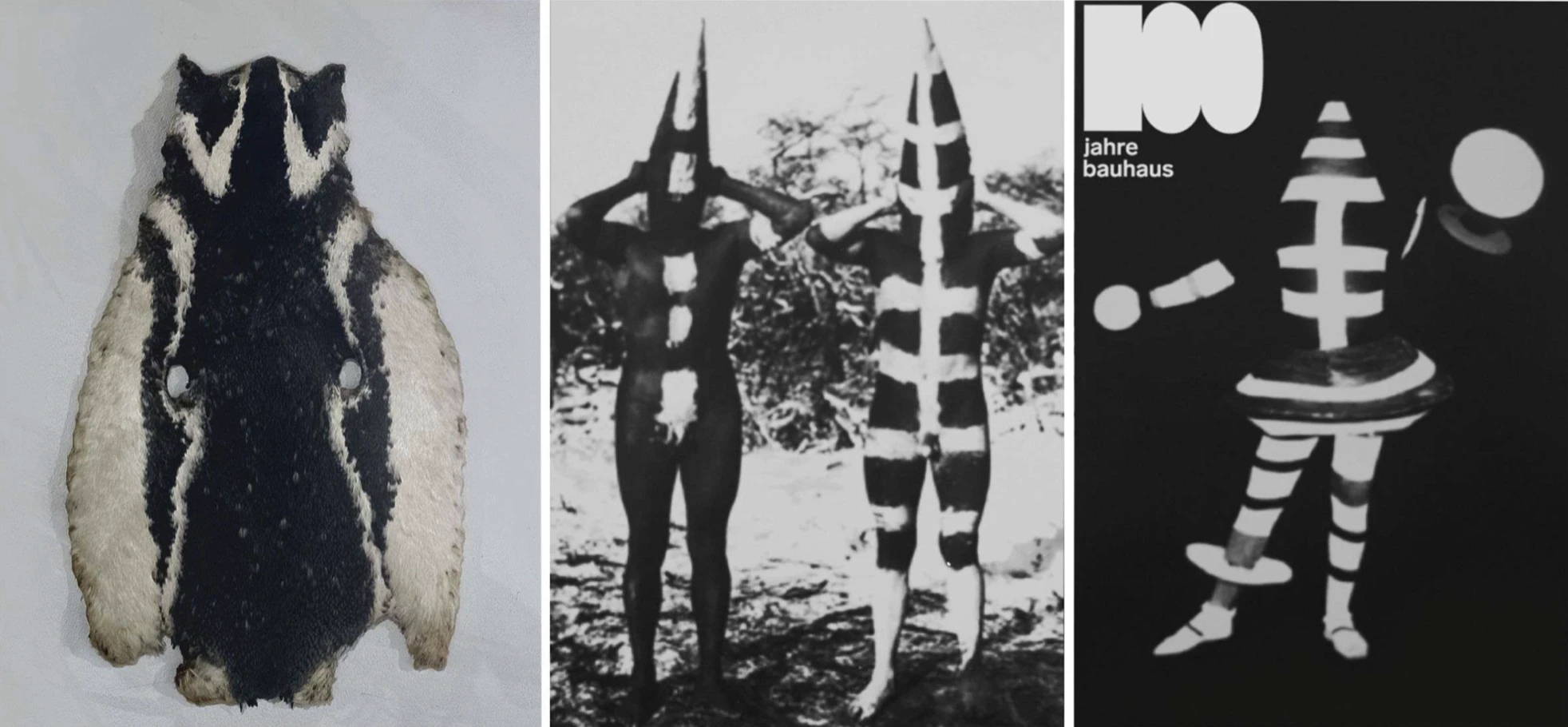
Penguin skin (Magallanes) — Selk'nam Hain ceremony, Gusinde 1919 — Bauhaus centenary poster, 2019
Bibliography
— Casali, R. (2013). Conquistando el fin del mundo. Prehistoria.
— Chapman, A. (1977). Economía de los Selk'nam. Journal de la Société des Américanistes, 64.
— Gusinde, M. (1974). Die Feuerland-Indianer. Halakwulup (Bd. 1).
— Nicoletti, M. A. (2006). Los misioneros salesianos. Anthropologica, 24(24).
— Soto Calderón, A. (2023). Imágenes que resisten. Ajuntament de Barcelona.
— Kreps, G., Martínez Pastur, G. J., & Peri, P. L. (2012). Cambio climático en Patagonia Sur.